Hybrid Mode of Working: Why Coworking Spaces Are Perfect (2026)
The hybrid mode of working is a blend of in-office and remote work, providing pr...
Himanshi Malhotra
29 Apr 2026
Himanshi Malhotra
29 Apr 2026
Setting up a Global Capability Center in India is one of the biggest and smartest moves a company can make. India offers technology, talent, and cost benefits that, at present, no other country can provide. But before you start, you need the right direction. From what a GCC is, to how coworking spaces are changing the way GCC companies set up and expand, and why India is their first choice, you will get to know everything. If you are looking for where to start from, alt.f coworking provides GCC-ready workspaces across multiple prime locations in Noida, Delhi, Gurgaon, Pune, Hyderabad, and Mumbai.
India is not just an outsourcing destination but the GCC capital of the world, with around 1,700 Global Capability Centers and a market projected to reach USD 99–105 billion by 2030. GCC companies are making India an important part of their business strategy, not just as a cost-effective option.
However, GCC setup in India has its own challenges, and one of the challenges is choosing the right workspace. This write-up breaks down everything for you about what a GCC is, why India is the top choice, and how coworking spaces help global companies set up smarter, faster, and with less risk.
Global Capability Center, also known as global in-house centers, captive centers or shared service centers. These are integrated facilities situated in popular regions such as India, which has now emerged as the GCC capital of the world. They leverage a combination of highly talented people and advanced technologies such as (machine learning, analytics, and AI). GCC helps businesses increase operational efficiency, drive exponential growth, and develop diverse capabilities.
In addition, a GCC may also be referred to as a Center of Excellence, offering best practices and specialized expertise that improve organizational innovation and performance.
These are some of the reasons why global capability centers are booming in India:
India is one of the largest producers of tech professionals, business graduates and engineers around the globe. Every year, millions of students graduate, which means businesses setting up a GCC in India never have to stress about hiring qualified people. You get people who specialise in HR, software, finance, and more. According to the NASSCOM–Zinnov India Report 2024, over 1.9 million professionals are already working in GCCs across India. This clearly shows that the workspace has experienced employees and understands how these companies operate.
Cost efficiency is one of the primary reasons companies choose India for GCC expansion. The cost you spend on hiring an experienced analyst or software engineer in India is a cost-effective option compared to what it would cost in the UK, Europe or the US. However, it is not just about the salaries, but also infrastructure, day-to-day operational costs, which are also lower. This is how the company can build a capable, large team in India in the same budget that they would get for a small team. With time, these savings get you millions, which you can use in your business product, innovation, growth or development.
Indian teams are developing AI tools, advanced technology, leading digital transformation programmes, and running data analytics for their parent corporation globally. When people from different educational backgrounds, areas, and regions work together, the results of global problems are remarkable. Approximately 120,000+ AI professionals are currently working within the Indian GCCs.
When a company positions itself in India, they are not just accessing Indian talent, but they are setting itself up in Asia, which is one of the fastest-growing regions around the globe. India, as a top country experiencing a rapid economic growth, has an operational base in this region, which means businesses can understand their customers better, respond to market changes and serve regional clients faster. If they managed everything from headquarters in London or New York, things would be different and difficult.
One of the biggest benefits of GCC in India is that it can easily scale. A company can start with a small team of 20 to 30 people and can grow to hundreds or thousands in a few years. In addition, they do not experience the headaches of logistics, financial or legal issues they would experience in their home country. Even with the rise of coworking space options, companies can scale up their physical infrastructure without being stuck in long-term commitments. As per the research of Zinnov, by the year 2030, India’s GCC market would reach USD 99–105 billion, which is a clear sign that the global companies are planning a long-term growth here.
One of the biggest challenges for global companies is talent retention. But global capability centers in India have a benefit here. When Indian professionals get to work in a well-known brand, it is extremely attractive for them. It offers them international exposure, better career growth, competitive salaries and more. In addition, over the past 5 years, the global leadership has been housed within the Indian GCCs, which means employees can now aspire to decision-making positions without ever leaving India. All this makes GCCs the best option to attract the best talent in the market.
If you want to know how to setup a GCC in India, it requires proper planning across operational, talent and legal dimensions. Here are the steps of how the process works:
Before you establish a GCC, conducting thorough market research is important. This includes:
The specific functions and services the GCC will provide
Availability of talent in main cities such as Hyderabad, Pune, Chennai, and Bangalor
Legal and regulatory requirements for setting up business operations
Researching the market helps you identify the right location and helps you decide the operating model, whether it is a hybrid or a fully captive GCC model.
If you are looking to set up GCC in India, you need to comply with the local laws and regulations, including:
Registration of Company: You need to register a legal entity in India, which can be a branch office, private limited company or a subsidiary.
Foreign Direct Investment (FDI) Approvals: In most sectors, India allows 100% FDI, which simplifies the entry process for international companies.
Labour Laws Compliance: Employers must follow India's labour laws covering employee welfare, wages and working hours.
Once you are done with the legal compliance, the next thing you need to do is to establish physical and IT infrastructure:
Office Space: India provides a wide range of options, from fully dedicated offices to coworking spaces in major IT hubs.
Technology Platforms: Proper IT infrastructure is important, including cloud services, data centers, reliable network connectivity and cybersecurity measures.
Partner and Vendor Selection: Choosing the right partner for HR, IT, legal and payroll services can speed up the setup process.
Once the infrastructure and legal foundations are in place, the GCC can start with full operations:
Process Alignment: Make sure the business processes align with the global standards to maintain consistency between the team.
Management: Build a strong team that is capable of managing daily operations while staying aligned with the global headquarters.
Performance Indicators: Use KPIs and regular feedback to check the ongoing improvements in operational efficiency and service quality.
The pace at which the global business is evolving in India is unpredictable. One year, it's scaling too fast, the other, you’re consolidating. That is where a coworking office space for GCCs comes into play. These workspaces let you resize floors, shift teams and more across multiple cities without long-term contracts. These are the reasons why GCC choose coworking spaces:
When every week you spend waiting for a physical office to be ready is a week of delayed hiring and less productivity. Shared office space helps you get rid of the wait entirely. High-speed internet, furnished workstations, IT support and meeting rooms under one roof. A team can be operational within the same week.
Maintenance, rent, admin and utilities are all covered in the coworking space's monthly membership plan. No large upfront deposits, no surprise bills and no separate vendor payments. For a GCC that is setting up in India, this type of financial benefit can make a lot of difference.
It is rare for business plans to go exactly as expected. A global capability center might plan 50 employees and end up needing 150 in a year itself. Coworking spaces make it easier, whether you need to scale up or down, it will only take a conversation with the operator.
Coworking spaces located in the prime business hubs provide a strong signal to prospective hires. This shows the company is modern, serious and thinks about their employees. The professional environment impacts the GCC’s ability to attract and retain the right talent.
Most of the shared office space operators have a strong presence in cities like Delhi, Noida, Gurgaon, Hyderabad, Pune and Mumbai. alt.f coworking presence across Noida, Delhi, Gurgaon, Hyderabad, Mumbai and Pune offers GCC premium workspaces to help expand their businesses. This means a global capability centers can expand to a new location through the same provider, same quality of space and the same processes, without beginning from scratch.
For a GCC setting up in India for the first time, the local compliance can be difficult. This includes establishment licenses, shop, registered address and GST registration, all these are required. Shared office space providers manage all this on behalf of their members, which helps reduce the administrative burden on the GCC team.
Setting up a GCC in India comes with a long checklist, and alt.f coworking ticks all these boxes, making it one of the reliable choices for GCC setup in India.
alt.f coworking spaces are present across Noida, Delhi, Mumbai, Gurgaon, Hyderabad and Pune. These are the top locations where India’s top GCC talent works, lives and commutes. Being in the right professional environment makes a big difference to employee retention, hiring speed and daily productivity.
alt.f coworking provides workspace solution that match exactly with GCC requirements:
5 to 50 Seats: Private cabins for startup teams
50 to 200+ seats: Fully-managed spaces for growing GCC teams
Enterprise suites: Branded, dedicated spaces for established GCC businesses that require control and privacy.
This means companies never have to worry about scaling up or down with alt.f, they simply move to the next level of space within the trusted partner.
alt.f offers members with a GST-registered business address, offers all essential documentation, including utility bills & No Objection Certificate (NOC), supports all establishment and shop requirements, and manages Principal Place of Business documentation. This helps GCC to be legally operational in India without spending weeks handling all legal work independently.
As we all know, GCC is not a startup, it is an extension of a global organisation. At alt.f coworking clients can display their company logo on the signage at the cabin entrance, giving the space a professional identity from the moment you walk in. If GCC needs further customisation, such as glass cabin partitions, they can discuss this with the FDM (Facility and Design Manager), depending on the availability at a certain location.
As GCC expands across India, alt.f grows with it. You get the same quality of space, same support and same processes. Whether a team is in Gurgaon, Noida, Pune, Hyderabad, Delhi or Mumbai. There is nothing like that you need to start from scratch in every new city. alt.f coworking presence in multiple cities means GCC expansion is a consistent, smooth experience from one location to another.
With over 1.9 million professionals already working across GCCs, new talent coming up every year, and coworking spaces supporting global enterprises. There has never been a greater time for GCC expansion in India. Shared office spaces offer global capability centers flexibility, infrastructure, professional environment and compliance support they need, from day one. Whether you are setting up for the first time or expanding your existing business, alt.f offers workspaces across different prime locations, so you can focus on expanding your business, not managing administrative tasks.
Everything you need to know, all in one place.
The hybrid mode of working is a blend of in-office and remote work, providing pr...
Himanshi Malhotra
29 Apr 2026
When we are talking about the comparison between coworking vs traditional office...
Himanshi Malhotra
21 Apr 2026
Shared office spaces have become a game-changer for startups and MSMEs in 2026, ...
Himanshi Malhotra
07 Apr 2026
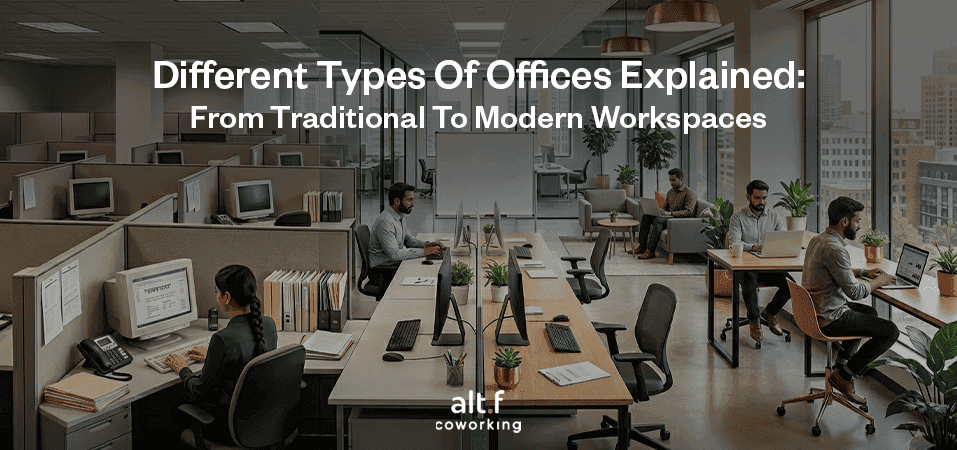
When it comes to building a productive workspace, knowing the types of office sp...
Himanshi Malhotra
02 Apr 2026
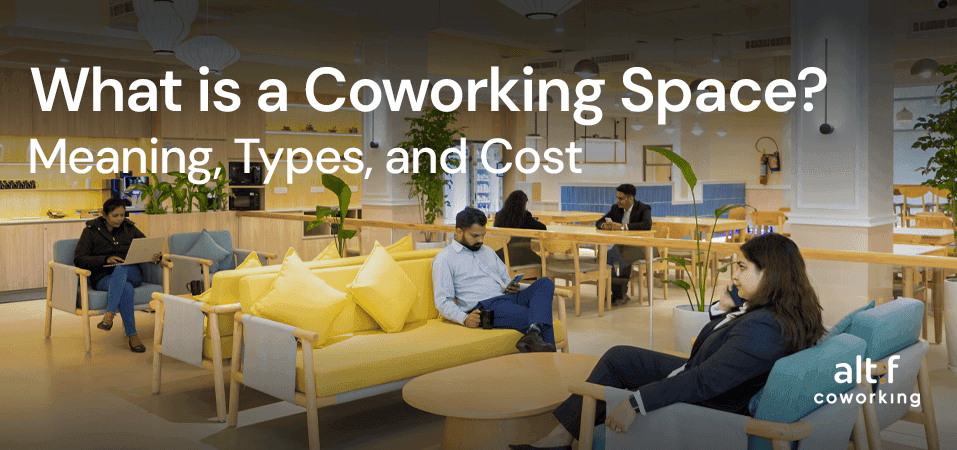
A coworking space is a fully-equipped workspace that offers flexible membership ...
Himanshi Malhotra
31 Mar 2026