Hybrid Mode of Working: Why Coworking Spaces Are Perfect (2026)
The hybrid mode of working is a blend of in-office and remote work, providing pr...
Himanshi Malhotra
29 Apr 2026
Himanshi Malhotra
02 Apr 2026
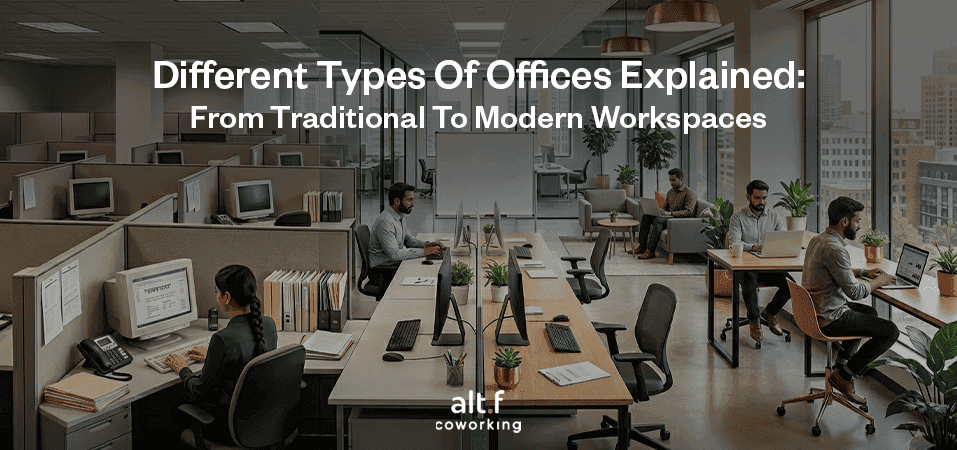
When it comes to building a productive workspace, knowing the types of office spaces available is the first step. From flexible coworking environments to traditional office setups, different types of offices suit different business budgets and needs. Additionally, types of offices and their functions vary; an executive suite works best for a travelling consultant, while a managed office suits a growing startup. As per (Mordor Intelligence), India’s shared office space market is projected to reach USD 7.71 billion by 2030, and the shift towards flexible offices is unstoppable. When you understand the main types of office environments, it will help you make an informed decision for your business and team.
Think about the time when you walked into an office, and it just felt right, the layout, vibe and energy. This feeling is not accidental. When a business chooses a workspace, it says a lot about how it operates. With several types of offices available today, the options can feel overwhelming. In fact, according to Mordor Intelligence, India's coworking office space market is estimated at USD 3.98 billion in 2025 and could reach USD 7.71 billion by 2030. All this reflects how fast workspace preferences are shifting. Knowing the different types of offices and their functions helps you make a choice that actually suits your budget, team and ambition.
Office space is where the work gets done and gives life to the company's vision. It is a place where professionals can focus on their tasks and also network with others. Traditional and modern office workspaces have different approaches to employee needs and work culture. With several options available, it is important to understand the types of office spaces to make the right choice. We have discussed the different types of workspaces available in today’s market.
About: A traditional office space is a workspace that a business owns or leases. It usually includes meeting rooms, private offices and a reception area. Additionally, physical offices offer more privacy and control for companies.
Best For: Physical offices are ideal for law firms, large companies, businesses and financial institutions that need privacy. Businesses like Tata Consultancy Services, major law firms such as Cyril Amarchand Mangaldas, work in dedicated physical offices to maintain client trust and brand authority.
Pros:
Provides private space to employees for confidential work
Dedicated spaces for different teams or departments
Better security and privacy
Perfect for companies with an established business
Cons:
A lot of money is required to set up, if you lease a prime commercial space in cities like Delhi or Mumbai, it can cost you around ₹200–₹400 per sq. ft./month
Offer less flexibility in terms of layout and design
About: A virtual office provides a prestigious business address, professional image and phone services without renting a physical office space. A company uses virtual addresses for meetings and mail handling. Moreover, the virtual office market has rapidly grown, and with the rise of remote work, reliable providers such as alt.f coworking are offering virtual office plans starting at ₹10,000/year in India.
Best For: Virtual office plans are best for remote teams, startups, freelancers, small businesses or businesses that don’t want to rent a traditional office space. This plan is especially popular among independent consultants, early-stage startups and expanding companies without signing long-term commitments. For instance, a Bengaluru-based company uses a Mumbai virtual address to deal with local clients professionally.
Pros:
Saves cost by eliminating the need to rent a physical office space
The flexible work setup allowed employees to work from anywhere
Provides a prestigious business address and mail handling services
Cons:
No offline interaction, this may affect the team culture and bonding
For some employees, it can lead to lower productivity
Also Read: What is a Virtual Office
About: Typically, an open space has a large, open space with fewer partitions. Additionally, this creates an environment that encourages communication among employees.
Best For: Open workspaces are perfect for tech companies, startups and creative agencies with a focus on teamwork. Companies such as Swiggy, Google, and Razorpay have utilised open office layouts.
Pros:
Promotes easy communication and teamwork
Easily adapt to changing needs
More affordable in terms of space. The open layouts can accommodate more employees compared to physical private offices
Cons:
Can be distracting and noisy
Can be uncomfortable for some employees due to a lack of privacy
About: A shared office space is the same as a coworking space, but generally shared by a few businesses. Businesses share resources such as reception areas, meeting rooms and other facilities, which help reduce the overhead costs.
Best For: Shared office spaces are ideal for small businesses, startups or teams that require a blend of shared resources and private space. This type of office is common among smaller cities and Tier 2 markets like Jaipur, Kochi and Pune, where two or small companies share a single office and split the expenses.
Pros:
Cost sharing helps reduce expenses, and companies can save up to 30 to 50% on the rent compared to renting a physical office space of the same size
Experience new opportunities for networking
Access to modern amenities such as meeting rooms, printers and common facilities
Cons:
Dispute over shared resources
Less control over the office environment
About: A coworking space is a space where individuals from various companies work together. You can access shared facilities like meeting rooms, lounge areas and high-speed Wi-Fi, all of which help the company to reduce expenses.
Best For: Coworking office spaces are ideal for remote workers, small businesses, startups and freelancers that need flexibility. India’s coworking sector has rapidly grown, with one of the reliable providers, like alt.f coworking, now having 16000+ workstations. This makes it one of the best choices for growing companies.
Pros:
Help reduce overhead costs
Provides networking opportunities, and for small businesses, this becomes the source of partnerships, key hires and clients
Access to premium office amenities
Cons:
Disagreement over the shared office space resources
Can hamper privacy
Also Read: What is a Coworking Space
About: Managed office is a fully-equipped office space offered by a third-party provider. Other than the rental agreement, it offers maintenance, utilities and other services. In India’s market, managed office space is projected to significantly grow, demanded by companies looking for plug-and-play solutions.
Best For: Managed offices are best for those businesses that need a fully-furnished office space that offers flexibility and minimal time to set up. Expanding companies from 50 to 500 employees, such as GCC (Global Capability Centres), MNCs' regional offices and funded startups, mostly choosing managed offices rather than physical office leases.
Pros:
You can start your work with the minimal setup time
Flexible rental agreements, usually ranging from 12 to 36 months, compared to traditional offices, which have 5-10 years of leases
Access to modern amenities like IT infrastructure, admin support and housekeeping
Cons:
Expensive compared to physical office leases
Not many options for customisation for office branding or layout
About: Private offices are dedicated workspaces within a coworking office space. These offices offer privacy and are best for businesses looking for a confidential space. One of the trustworthy providers, like alt.f coworking, offers private office solutions that can accommodate teams of approximately 2 to 40 people, making it a great option for expanding teams.
Best For: Private offices are suitable for companies that require a private, noise-free space, such as consultants, law firms or businesses managing confidential information. Companies like boutique investment banks and accounting companies usually choose private offices to balance exclusivity with flexibility.
Pros:
Excellent privacy and control over your space
Professional setting that enhances brand credibility with clients
Provided security for confidential work
Cons:
More expensive than shared office spaces
Less opportunity for collaboration and networking
About: An executive suite is a fully-furnished, private office space, offering modern amenities like a professional business address, receptionist services, superior interiors and access to boardrooms. Additionally, in India, the prices may depend on location and size, which is significantly less expensive than a standalone office.
Best For: Executive suites are an ideal option for small executive teams, solo professionals, consultants and financial advisors who require a fully-furnished, professional private office without expensive overhead costs. Additionally, it is also a best fit for C-suite executives or regional managers who frequently travel and require a professional base in different cities.
Pros:
Showcase a professional, premium image that helps build a credible business image in front of clients
Fully-furnished space, which helps eliminate the time and capital expenditure
Offers services like mail management, call handling, reception and more
Cons:
More expensive compared to a physical office lease
Less scope for customization
Choosing the right types of office space depends on different factors like business budget, size and operational requirements. These are some of the tips that can help you make an ideal choice:
Know your needs: Create a list of total employees, the preferred location and required facilities.
Consider budget: Analyse the cost linked with each type of office and choose the one that fits under your budget.
Flexibility: Look into the potential future expansion and the lease terms.
Preferences of employees: Consider your employees' work preferences and the impact on their satisfaction and productivity.
Amenities and services: Check what amenities and services are essential for your business operations.
The concept of office spaces is changing to align with the modern work environment, which gives rise to different types of offices that offer flexible solutions. In addition, these solutions suit the various business needs. Here are many factors that are influencing this change:
The well-being of employees is now the main consideration in various kinds of offices. Features like natural lighting, recreational facilities and ergonomic furniture help to improve the workspace comfort. Different types of workspaces are designed to be wellness-focused to enhance job satisfaction and productivity.
Now, mostly businesses are prioritising sustainability in office design. Green spaces, energy-efficient lighting and eco-friendly materials are becoming common in different types of office spaces. Moreover, businesses are choosing offices that reduce their carbon footprint, environmental responsibility and operating expenses.
Modern workspaces are becoming more comprehensive by fulfilling different requirements. Several kinds of offices are now designed to accommodate different individuals and support multicultural environments. Quiet zones and flexible work arrangements are some of the measures that different types of offices are adopting.
Overall, no office type is perfect; it all depends on what exactly your business needs. India’s workspace landscape is rapidly changing, with providers like alt.f coworking with over 16000+ workstations already meeting the different business needs. As you now know the different types of offices, don’t rush to the conclusion, consider your team, where you are headed and your culture. The ideal office does not just give your team a space, but it also motivates them. So, take your time, choose a space, ask the right questions and work as hard as you can.
The hybrid mode of working is a blend of in-office and remote work, providing pr...
Himanshi Malhotra
29 Apr 2026
When we are talking about the comparison between coworking vs traditional office...
Himanshi Malhotra
21 Apr 2026
Shared office spaces have become a game-changer for startups and MSMEs in 2026, ...
Himanshi Malhotra
07 Apr 2026
Everything you need to know, all in one place.
Setting up a Global Capability Center in India is one of the biggest and smartes...
Himanshi Malhotra
30 Apr 2026
The hybrid mode of working is a blend of in-office and remote work, providing pr...
Himanshi Malhotra
29 Apr 2026
When we are talking about the comparison between coworking vs traditional office...
Himanshi Malhotra
21 Apr 2026
Shared office spaces have become a game-changer for startups and MSMEs in 2026, ...
Himanshi Malhotra
07 Apr 2026
A coworking space is a fully-equipped workspace that offers flexible membership ...
Himanshi Malhotra
31 Mar 2026