Hybrid Mode of Working: Why Coworking Spaces Are Perfect (2026)
The hybrid mode of working is a blend of in-office and remote work, providing pr...
Himanshi Malhotra
29 Apr 2026
Himanshi Malhotra
30 Sept 2025
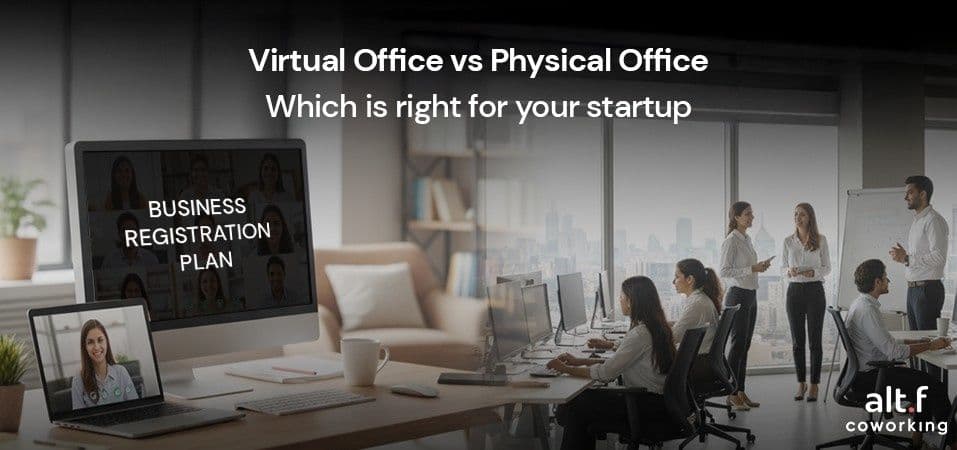
Running a startup comes with tough choices, one of which is choosing between a virtual office and a physical office. Virtual offices offer lower costs, flexibility, and a professional address in various cities, including Noida, Delhi, Gurgaon, and Hyderabad. It makes it perfect for startups in terms of growth and for remote teams. Physical offices provide a strong team culture, engage in collaboration and in-person client interactions, though you have to pay higher costs. That is why numerous startups choose a hybrid model, trying to combine both traditional and digital strategies. Reputable providers like alt.f coworking make it easy by offering virtual office and physical office services to meet the unique needs of businesses of all sizes.
Are you a startup founder thinking about whether to choose a virtual office or a physical office? You are not alone. According to a 2025 report, 87% of job seekers prefer to work remotely. Companies that prefer flexible work areas can reduce their operational expenses by as much as 75% as opposed to physical offices. But does it mean a virtual office space is the ideal choice for a startup?
Let’s make it simpler for you. If your goal is low overhead, flexibility, and you want to expand across different cities like Gurgaon, Delhi, Hyderabad, or Noida, a virtual office could be a good option for you. However, if your startup prioritises face-to-face teamwork, wants to build a strong office culture or direct client interactions, a traditional office may be a better option.
By the end of this write-up, you’ll better understand the differences between virtual office vs physical office, their advantages and challenges and how to choose the right office space for your startup. Continue reading!
A virtual office is an area that lacks a physical office address and typically offers a collaborative and communicative environment. Virtual offices include services like mail handling, verified business address, a specific phone number and office facilities and meeting rooms when required. Any business can use this virtual office, whether it be startups, freelancers, small businesses or remote teams, according to their requirements. However, there are some virtual offices that require a lease agreement or advanced reservations.
Individuals may use the virtual office to work on tasks or projects from remote locations outside of their workspace. Additionally, it can be an ideal option for those companies that have remote workers, organisations with a set budget or small businesses seeking a productive space to conduct meetings.
A physical office is the primary workplace where all employees report. Physical offices may offer your company an official location and other business essentials like receptionists and phone systems. Additionally, the physical workspace can be a single rented space in a building or a whole building with meeting rooms. Physical offices are best for those businesses that require in-person collaboration, prioritise company culture and provide face-to-face client services. A traditional office is the best way to provide your team with a designated hub if they want to be surrounded by their co-workers day to day. Also, it is a great option if your team is engaged in collaborative work, as it may be useful in creative projects.
Virtual office and physical offices have their individual differences that make them beneficial for different kinds of businesses. Let’s take a quick look at it:
Feature | Virtual Office | Physical Office |
|---|---|---|
Flexibility | Provides high flexibility, you can work from anywhere | Settled location, and less flexible |
Cost | Generally includes only services (lower cost) | Higher cost for utilities, rent, and maintenance |
Team Collaboration | Limited use of digital tools and virtual meetings | In-person meetings and direct interaction with clients |
Scalability | Easy to scale up or down by adjusting service packages | Scaling requires expanding or relocating to a larger area |
Dedicated Address | Professional address without physical space | Physical appearance at a specific location |
Access to Technology | Easy access to digital means | Access to office tools and technology |
Mail Handling | Handled by the service provider | Handling and sorting on-site |
Operational Costs | Lower operational costs | Higher operational costs (cleaning, utilities, etc.) |
Brand Presence | Helps improve brand impression | Stronger presence, improves credibility |
So, are you thinking about how a virtual office can benefit your company? There are several benefits of using a virtual office for your startup or small business and different types of businesses. Whether it be remote work or business support, take a glance at the advantages of a virtual office:
Having a professional business address through a virtual space ensures that your brand maintains a professional, credible and legitimate presence. When you use a physical business address and dedicated phone number on your website and business cards, this builds trust among the clients.
Choosing a virtual business address in a well-established area, aligning with your business goals, improves your brand’s image. For instance, when you use a virtual office in Delhi, virtual office in Gurgaon, virtual office in Noida or virtual office in Hyderabad for your company in a well-known location, it can improve your business reputation. The benefits of the virtual offices let you work from anywhere while maintaining a reputable city address.
One of the primary benefits of virtual office space is the ease of working from anywhere you want to. Virtual offices are ideal for those who want to work with more flexibility, be it at home, the park or the beach. If to run your business you all need an internet connection, then a virtual office is your go-to solution. This is the main benefit of virtual offices for present-day businesses.
One of the benefits of virtual workspaces is that you can get rid of the physical office; therefore, there is no need to commute daily. This makes the virtual space a more environmentally friendly option than physical office space. By reducing the number of daily commutes, you will reduce the amount of carbon dioxide in the atmosphere and make the planet healthier. In addition, no commute means no more suffering from traffic or the hassle of public transport. This gives you more time to focus on your business.
Virtual office services are a great choice for those looking to enhance their productivity and employee satisfaction, as they help employees to work from anywhere. Also, it saves on the cost of commuting, and you can enjoy a work-life balance. According to the survey, those doing WFH (Work From Home) were 20% happier than those working from the office, which also results in less stress and lower employee turnover. Apart from this, when employees work in a relaxed environment, they tend to be more productive, with fewer distractions, which is a significant benefit when you opt for a virtual office.
One of the likeable benefits of office space for startups and other businesses is that it is more cost-effective than a physical office. Rather than investing in an office space or renting one, you can invest in a virtual business address without any high cost. Additionally, this also lowers the expenses like office equipment, commuting, maintenance and utilities, you can use your funds where they are most needed, like in growing your business.
Virtual offices let you do easy expansion of your business, like you can build your presence in new locations, have multiple offices around the country, and hire new talent without the worry of shifting to a physical office space. This flexibility is affordable and stress-free compared to a traditional business expansion.
For hybrid and remote teams, a virtual office is like a central hub that improves collaboration, communication and productivity while still maintaining a professional identity. Services like call handling and professional mail ensure official communication. Other than this, virtual offices can provide you with on-demand access to coworking spaces and physical meeting rooms. This provides you with a professional environment for face-to-face client meetings, training sessions and in-person collaboration when required.
Many virtual offices include virtual office plans that operate on a monthly or ad-hoc basis, which means you do not have to worry about long-term contracts. This type of flexibility helps to reduce the risks, allowing you to use the services of a virtual office as long as you require, without being stuck in rental contracts.
Another best thing about using a virtual office is that you have access to a larger talent pool. Since you don’t have to worry about the location, you can easily do your hiring process. Businesses of all sizes are able to hire talent from anywhere in the world without the need to commute and relocate to a traditional office.
Virtual office plans generally include a range of features to help support your business, allowing you to focus more on your business. This includes mail forwarding, call handling and access to the meeting rooms. It helps ensure that your business has access to everything that is required to run efficiently and smoothly, without the need for a traditional office.
While it may be easy for you to conduct all your meetings over Teams and Zoom, according to the studies, it is not the best way to boost your business efficiency and productivity. As a startup, you are at a crucial stage in your business. Here are the benefits of a physical office for a startup:
A physical office space for a startup is a legitimate, professional image that can build confidence in investors, clients and partners. With a traditional office, you get a dedicated location that builds your brand identity and showcases that your business is stable and serious.
A shared office space for rent encourages face-to-face interaction, which fosters better teamwork, communication, and you can brainstorm more. Also, it helps you build a better company culture. Working from a dedicated location allows you to have easy communication and quick feedback, which is important for startups.
When a startup has a physical space, it has full control over the workspace, whether it be IT infrastructure, layout and branding. With the help of this, the business can implement certain security protocols and can design the office that reflects its goals and vision without being stuck with the coworking office policies. Additionally, it allows the business to customise a workspace that reflects the company’s professional look.
A traditional office is generally about permanence and stability, which can be important to attract and retain the confidence of employees, partners and investors. The physical presence of the business showcases its long-term commitment to the business and makes it appear more transparent and reliable than a virtual office space.
A traditional office space offers a professional setting for face-to-face meetings with partners, clients and potential investors. Being in a branded, dedicated space is generally impressive and builds more trust than relying on just virtual interactions or having a meeting in a coffee shop. In addition, for some of the businesses, having a physical space is still an expectation that helps to make deals final.
However, virtual offices provide several benefits, but they come with their own set of challenges. One of the main challenges is communication. Without in-person interaction, it can be complicated to build relationships and maintain effective communication with the team. This can cause misunderstanding, lack of cohesion and conflicts. Let us take a deeper dive and talk about the challenges:
The absence of face-to-face communication can cause misunderstanding, as body language is missing from digital communication, such as chat and email.
A traditional office space creates a common culture, and you feel that you belong to this place. In the virtual office space, it gets challenging to fulfil these needs.
Remote work can make you feel isolated and lonely, especially for those employees who miss social interaction in an office environment. This can impact their engagement and job satisfaction.
When a business chooses a virtual office, it creates a dependency on the service provider for the important functions. This includes call answering, mail handling and access to meeting rooms. In addition, any misfortune, such as bad receptionist service or delayed mail, is a direct reflection of the brand image, and this might interfere with operations.
For businesses where there is more customer traffic, a virtual office is not a suitable option. Virtual office setup is designed for remote office space, not for unannounced visitors. Customers who visit the registered office address will find it difficult because of the absence of the company's own staff, which can lead to damage to the business’s image.
Physical office space offers certain advantages, like a better team culture and dedicated workspace, but it also has its own set of challenges. The issues have the potential to affect the growth and effectiveness of a startup. These are some of the challenges of physical offices:
A traditional office needs financial investment, and the daily expenses can be a big burden, especially for small businesses and startups. The cost is not just limited to the monthly rent, it includes insurance, maintenance, equipment and furnishings. For instance, a business having limited capital, these high expenses can cause issues in core operations like marketing, talent acquisition and product development.
Physical office space generally requires long-term contracts, usually for 3 to 5 years. This long-term agreement can be challenging for growing businesses and startups, which need to quickly adapt to the market needs. Being stuck in a long-term commitment can force a business to pay for space that is unused or more. Also, when a business tries to break the lease early, it can face heavy penalties, which creates a financial risk.
With traditional office space, you can not expect to have good flexibility. If a business needs to grow in the market, it must go through an expensive and time-consuming process to fit into a new and larger office. On the other hand, flexible virtual space allows the business to stay flexible and pay only for the resources they need and use in the given time period.
When you choose a physical location, it can be challenging for both employees and the business. A traditional office can lead to stressful and long commutes for the employees. This can negatively impact their productivity, morale and work-life balance. In addition, a physical location can create difficulties when trying to reach the customer base that is growing in different geographical areas.
Deciding between a virtual office vs physical office depends on your business goals and model. This is because it can impact everything from talent and budget to company culture and productivity. According to 2025 data, here are all the details on which you can make your decision.
A virtual office for startups mostly works digitally, has a limited budget, and gives more priority to flexibility. Startups that opt for virtual offices can save a good amount of overhead costs; some reports showed savings of up to 75% over traditional office spaces. Additionally, in 2025, 87% of the job seekers prefer remote work, and 60% of them are dropping out due to the unclear company’s flexibility policy. However, there are some challenges as well, like (a report shows 40% potential isolation of remote workers), and some have faced burnout from digital communication tools.
This is an ideal choice for those startups that mostly require face-to-face collaboration and have good final resources for overhead costs. If you run financial or legal services, a traditional office space can be your key to closing deals. When you engage in face-to-face meetings, it can build stronger relationships with the clients and investors. With a dedicated space, you can build a team culture, and according to a 2025 study by Gartner, when you feel more connected with others at work, this increases employee performance by up to 37%. However, a physical office can come up with many challenges, such as on-site distractions and commuting stress.
Overall, for startups, the choice between the virtual and physical office depends on their budget and operational needs, with the type of team culture they want.
Choosing between a virtual office vs a physical office, both have their own advantages and challenges. A virtual office for startups offers you flexibility, affordability and scalability. This makes it ideal for businesses wanting to save costs or build their presence across different cities. Apart from this, a physical office provides stronger collaboration, stability and a professional space for investor and client interactions; however, it has less flexibility and a higher cost.
The decision of choosing the right entirely depends on your business budget, stage and industry needs. Both options have their advantages and disadvantages, and the best one is the one that meets your long-term goals and team culture. Additionally, many of the businesses find better results when both are combined. A hybrid approach typically involves utilising a virtual office space for administrative tasks, while also utilising physical spaces for collaboration. A provider like alt.f coworking offers both great options, allowing businesses of all sizes to establish their brand image. From startups establishing their business address and access to fully equipped, premium physical spaces, including meeting rooms, private cabins, dedicated desks, and more. alt.f coworking balances cost-efficiency and fosters strong team bonds, and maintains a professional image to clients.
The hybrid mode of working is a blend of in-office and remote work, providing pr...
Himanshi Malhotra
29 Apr 2026
When we are talking about the comparison between coworking vs traditional office...
Himanshi Malhotra
21 Apr 2026
Shared office spaces have become a game-changer for startups and MSMEs in 2026, ...
Himanshi Malhotra
07 Apr 2026
Everything you need to know, all in one place.
Setting up a Global Capability Center in India is one of the biggest and smartes...
Himanshi Malhotra
30 Apr 2026
The hybrid mode of working is a blend of in-office and remote work, providing pr...
Himanshi Malhotra
29 Apr 2026
When we are talking about the comparison between coworking vs traditional office...
Himanshi Malhotra
21 Apr 2026
Shared office spaces have become a game-changer for startups and MSMEs in 2026, ...
Himanshi Malhotra
07 Apr 2026
When it comes to building a productive workspace, knowing the types of office sp...
Himanshi Malhotra
02 Apr 2026